
Industry Insights
Cork vs Ceramic Coasters: What Actually Protects Wood
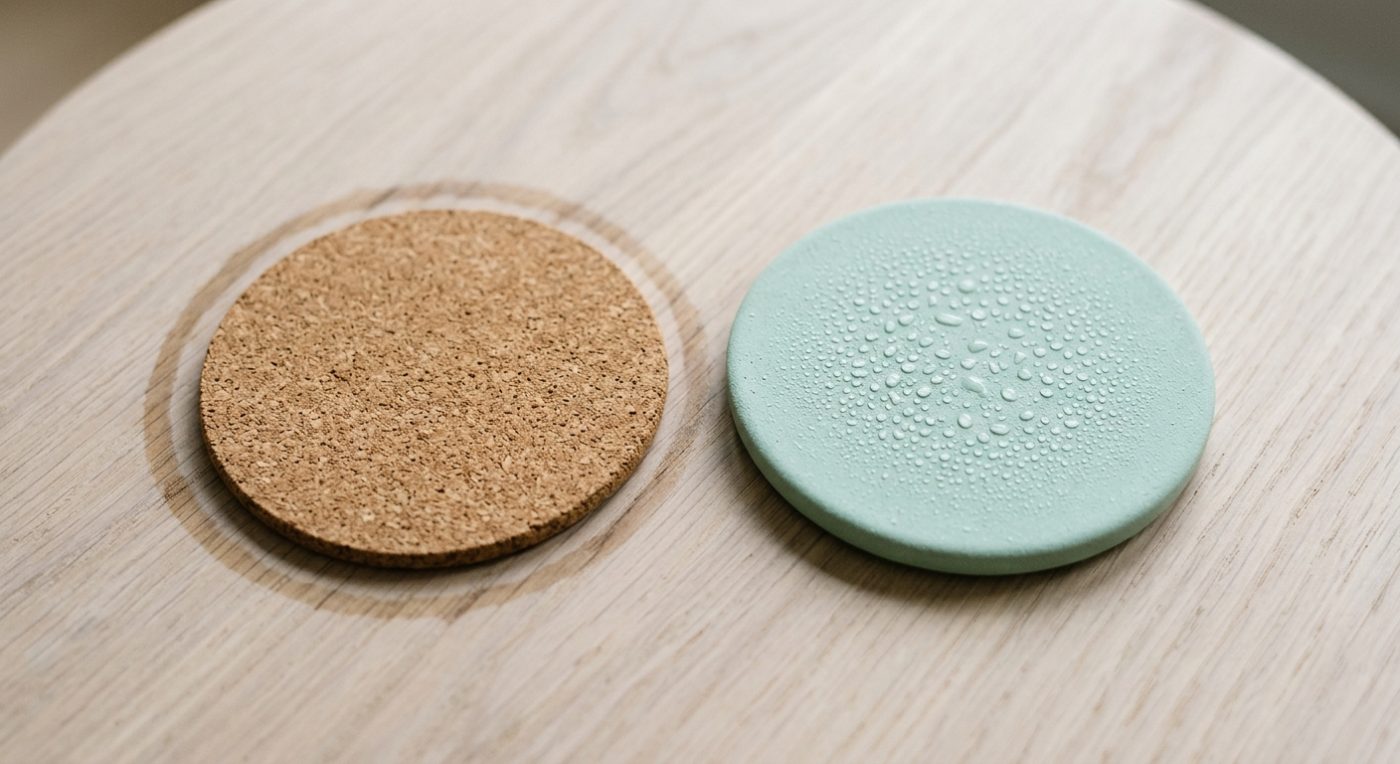
Sep
TL;DR
Cork soaks up condensation and insulates heat, while glazed ceramic sheds liquid and cleans easily, so match the coaster to what you actually drink.
- White rings are moisture trapped in the finish, dark rings mean water reached the wood, and heat haze can happen with no spill at all.
- Choose cork for cold drinks that sweat and for hot mugs, but expect staining from dark drinks and crumbling edges over time.
- Choose glazed ceramic if you want a surface that wipes clean, resists red wine and coffee stains, and lasts, and check the underside is soft enough not to scratch.
The Real Question Behind Cork vs Ceramic Coasters
Ask ten people about cork vs ceramic coasters and you’ll get ten confident answers. Most of them are based on a single bad experience with a ring on a table. That’s not much to go on.
The truth is that both materials can protect wood. They just fail in different ways, under different conditions.
If ceramic is the way you're going for your wood surfaces, browse our handcrafted ceramic coasters and car coaster sets, made in our studio in dog breed, sea life and automotive designs.
Learn more →Wood finishes get damaged by three things: moisture, heat, and abrasion. A coaster has to handle all three to earn its spot.
So the useful question in cork vs ceramic coasters isn’t which material wins. It’s which one matches the drinks you pour and the table you own.
What Actually Damages a Wood Finish
White rings on a table aren’t stains in the wood itself. They’re moisture trapped inside the finish layer, usually a lacquer or varnish. The water clouds the finish from underneath.
Dark rings are worse. That’s moisture that got past the finish and reached the wood, where it reacted with tannins. Those often need sanding to fix.
Heat causes its own problem. A hot mug can soften a finish and leave a hazy patch even when nothing spills at all.
Then there’s plain scratching. Grit on the bottom of a glass, or a coaster dragged across the surface, will dull a finish over time.
A good coaster deals with all four. Here’s what each type of damage really needs:
- Condensation needs a surface that absorbs or holds liquid away from the wood
- Spills need a rim, a lip, or enough absorbency to buy you time
- Heat needs a material that doesn’t transfer warmth quickly
- Abrasion needs a soft underside that sits flat and doesn’t slide
How Cork Handles a Cold Drink
Cork is naturally absorbent and slightly compressible. That combination does real work against condensation. Water beads roll off a glass and soak straight into the surface.
That absorbency is also cork’s weakness. What goes in has to come out, and it does so slowly. A saturated cork coaster left on a table can push moisture downward.
Cork is also a genuinely good insulator. It handles a hot mug better than most people expect, which makes it a reasonable pick for tea and coffee.
The soft surface is kind to table finishes too. Cork won’t scratch a lacquer, and it doesn’t slide around much when you set a glass down.
Wear is where cork shows its age. Repeated wetting and drying can make it crumble at the edges, and dark drinks stain it permanently.
How Ceramic Handles the Same Job
Ceramic behaves differently depending on how it was made. An unglazed or partly unglazed ceramic coaster absorbs water quickly, much like a stone tile would.
A fully glazed ceramic surface absorbs nothing. Liquid sits on top of it instead. That’s great for wiping up, less great for condensation that runs off the edge.
This is the main split in the cork vs ceramic coasters debate. One material soaks, the other sheds. Neither is automatically better.
Ceramic wins on cleaning and on longevity. A glazed surface doesn’t stain from red wine or coffee, and it won’t crumble after a year of use.
Ceramic loses on the underside. Bare ceramic against a wood table is hard, and hard means scratches. That’s why backing matters so much.
Why the Backing Matters More Than the Face
Here’s the thing most people miss entirely when they compare cork vs ceramic coasters. The side you look at is not the side doing the protecting. The underside is.
A ceramic coaster with a cork or felt backing gets the best of both. The face resists stains and wipes clean, and the soft base cushions the table.
That backing also lifts the coaster very slightly. Air can move underneath, which lets trapped moisture escape instead of sitting against the finish.
Check the backing on anything you already own. If it’s bare ceramic, glass, or hard plastic, it’s making contact with your finish every single time.
A few things worth looking for on the underside:
- Full coverage rather than four small dots at the corners
- A backing that’s bonded evenly, with no lifting edges
- Enough thickness to create a small gap for airflow
- A material that stays put when the coaster is picked up damp
Matching the Coaster to How You Actually Drink
Think about what ends up on your table most often. That single habit should settle cork vs ceramic coasters for you more than anything else.
If it’s mostly hot drinks, insulation matters most. Cork handles heat well. So does a thicker ceramic piece with a soft backing under it.
If it’s iced drinks in summer, condensation is the enemy. You want either strong absorbency or a design that catches runoff before it reaches the edge.
If red wine and dark juice are common, staining becomes the deciding factor. A glazed surface stays looking new far longer than an absorbent one will.
And if the table is antique or freshly refinished, be more careful than you think you need to be. Older finishes are softer and far less forgiving.
Caring for Both Kinds So They Keep Working
A coaster only protects for as long as it stays in good shape. In the cork vs ceramic coasters comparison, both materials need a bit of attention, just different kinds.
Cork should be allowed to dry fully between uses. Stacking damp cork coasters traps moisture and speeds up the crumbling you’re trying to avoid.
Glazed ceramic wipes clean with a damp cloth and a little dish soap. Avoid abrasive pads, since they can dull the glaze over time.
Check backings every few months. Felt and cork can loosen with repeated damp, and a lifted corner is where scratches start.
A few habits that extend the life of either type:
- Lift rather than slide coasters across the table
- Wipe the underside if a glass has overflowed
- Let absorbent coasters air dry face up
- Replace anything with a worn or missing backing
- Keep a few extras so none get overused
Protecting wood isn’t really about picking a winner in cork vs ceramic coasters. It’s about understanding what your table faces and choosing accordingly.
→Handmade Holiday Gifts for People Who Have Everything→Gifts by Dog Breed: Ceramic Car Coaster Sets They'll Actually Use
Frequently Asked Questions
Do cork or ceramic coasters protect wood better?
Both can protect a wood finish, they just fail in different ways. Cork absorbs condensation and insulates against heat, while a glazed ceramic surface sheds liquid and never stains or crumbles. The right pick depends on what you drink and the table you're setting it on.
What actually causes white rings on a wood table?
White rings aren't stains in the wood itself. They're moisture trapped inside the finish layer, usually a lacquer or varnish, which clouds the finish from underneath. Dark rings are worse because the moisture has reached the wood and reacted with tannins, and those often need sanding to fix.
Can a coaster protect against heat as well as moisture?
Heat is its own kind of damage. A hot mug can soften a finish and leave a hazy patch even when nothing spills at all, so the material needs to slow heat transfer. Cork is a genuinely good insulator, which is why it handles tea and coffee better than a lot of people expect.
Why does cork wear out faster than ceramic?
Cork is absorbent and slightly compressible, which is great against condensation but hard on the material over time. Repeated wetting and drying can make it crumble at the edges, and dark drinks like red wine and coffee stain it permanently. A glazed ceramic surface doesn't absorb anything, so it stays clean and intact much longer.
How do I clean a ceramic coaster?
A fully glazed ceramic surface absorbs nothing, so liquid sits on top rather than soaking in. That means a wipe with a damp cloth or a little dish soap and water handles most spills, including coffee and red wine. Avoid dragging a coaster across a table surface, since grit underneath can dull a finish over time.
What kinds of ceramic coasters does LC Designs make?
We make ceramic coasters and ceramic car coaster sets, with designs covering dog breeds, sea life and automotive themes. Everything is produced in-house in our studio, including printing, sublimation and finishing. Products are sold as listed at lcdesigns.cc and shipped to you.

