
Tips & How-To
Sea Life Motifs: Telling Coral From Anemone in Art
Sep
TL;DR
Coral reads as rigid branching structure while an anemone shows soft tentacles radiating from a central disc, and that difference changes how you read small sea life pieces.
- Look for repeated forking branches, a stable base and warm reds, oranges or bleached white to identify coral in artwork.
- Spot an anemone by its wavy tapering tentacles fanning out from a clear centre, often in brighter purples, teals and pinks.
- On small surfaces like ceramic coasters and 3D printed earrings, fine detail gets lost, so a good design keeps the one silhouette cue your eye needs.
Two Shapes That Look Alike Until You Slow Down
Sea life motifs show up everywhere in home decor, and two of them get mixed up constantly. The coral vs anemone art question comes up more than you’d think. Both are branching, colourful, and unmistakably ocean.
They’re not the same thing, though. Coral is a colony structure. An anemone is a single animal with tentacles.
Now you can spot the difference, browse our sea life sculptures and ceramic coaster sets to find the coral, anemone and ocean designs you like best.
Learn more →Once you learn to spot the difference, you can’t unsee it. It changes how you read a coaster, an earring, or a small sculpture.
We make sea life pieces here at the studio, so we look at these shapes a lot. Getting them right matters to us. Describing them honestly matters even more.
What Coral Actually Looks Like in a Design
Coral reads as structure. It’s rigid, branching, and usually repeats the same shape over and over. Think of it as architecture rather than an animal.
In artwork, coral often has hard edges. The branches fork, then fork again. Nothing about it looks like it would move in a current.
Colour is a clue too. Coral in decor tends toward warm tones: coral pink, orange, dusty red. Some designs lean into bleached white or pale cream instead.
Here’s what usually signals coral in a piece of artwork:
- Repeating branch patterns that split at similar angles
- A solid, tree-like or fan-like silhouette
- Textured surfaces, sometimes drawn with tiny dots or ridges
- A stable base, as if it’s anchored to rock
- Warm reds, oranges and pinks, or a chalky bleached white
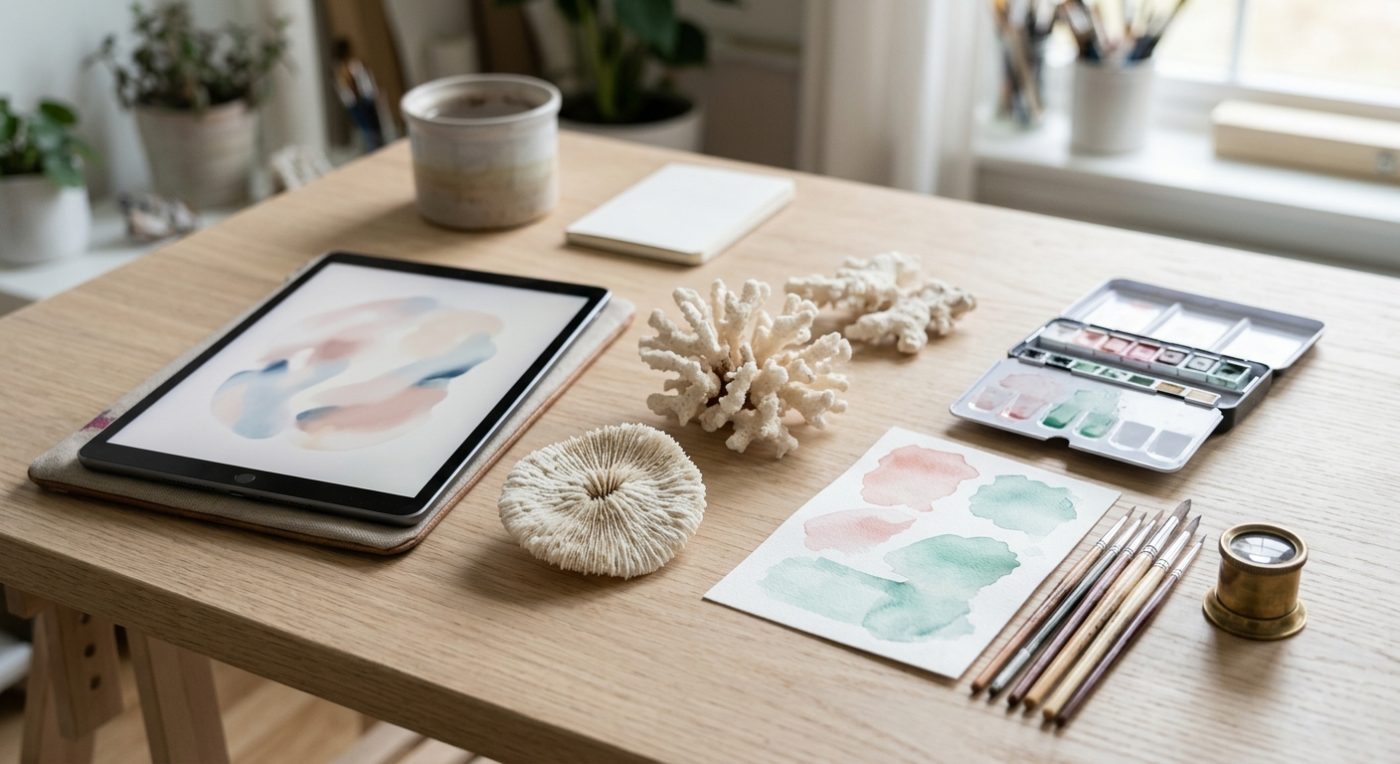
Brain coral is the easy one to name. It’s the round, maze-patterned form that shows up in a lot of coastal artwork.
How Anemones Give Themselves Away
Anemones are softer. Everything about them suggests movement, even in a still image.
The tentacles are the giveaway. They’re usually drawn as loose, wavy strands radiating out from a central point. They taper. They curl. They don’t fork the way coral branches do.
An anemone also has a clear centre. Look for a mouth or disc at the middle, with tentacles fanning outward from it. Coral rarely has that focal point.
Colour tends to go brighter and more playful. Purples, teals, hot pinks and greens turn up often in anemone illustrations.
Anemones are also the ones you’ll see paired with clownfish in artwork. That pairing is so common it’s become a shorthand for the whole motif.
Why the Difference Shows Up on Small Pieces
On a large print, you have room for detail. On a coaster or an earring, you don’t. That’s where the coral vs anemone art distinction gets interesting.
Small formats force a designer to pick the strongest cue and lead with it. For coral, that’s the branching silhouette. For an anemone, it’s the radiating tentacles.
We print on ceramic coasters and on 3D printed earrings. Both have limits on how fine a detail can go before it turns to mush.
So good small-format sea life motifs simplify on purpose. They keep the shape that tells your eye what it’s looking at, and they let the rest go.
That’s not a shortcut. It’s the whole craft of designing for a small surface.
Reading Sea Life Motifs Like a Collector
Once you know the two shapes, you start noticing how artists combine them. A lot of ocean scenes use both in the same frame.
Coral usually sits at the bottom, forming the landscape. Anemones tuck in among it, adding softness and colour contrast.
That layering is deliberate. The rigid shapes give a composition its bones. The flowing shapes give it life.
Watch for a few other sea life motifs that share the frame:
- Sea fans, which are flat, lacy coral forms that look almost like leaves
- Kelp and seagrass, drawn as long vertical ribbons
- Starfish, which anchor a composition with a clear geometric shape
- Jellyfish, which share the anemone’s flowing tentacles but float free
- Shells, used as accents rather than the main subject
Jellyfish trip people up for the same reason anemones do. The tentacles look similar. The difference is that a jellyfish has a bell and no anchor point.
Choosing a Sea Life Piece for Your Home
Knowing the difference helps you shop with more intent. You’re no longer picking “something ocean.” You’re picking a specific feeling.
Coral motifs tend to feel calm and structured. They sit well in rooms that already have clean lines and neutral tones.
Anemone motifs bring energy. The colour is usually bolder and the shapes are looser, so they work as a small pop against a plain background.
If you’re buying a set of sea life motifs, think about balance. A mix of structured and flowing designs reads better together than four of the same silhouette.
We make our sea life pieces in the studio, printing and finishing each one here. A design goes in the shop when the print and finish are right, and not before.
Looking Closer at What’s Already Around You
The nice thing about learning these shapes is that it’s free and it sticks. You’ll start spotting sea life motifs on packaging, fabric and tile.
Most sea life artwork isn’t trying to be a field guide. It’s trying to evoke a place. Accuracy is a bonus, not the point.
Still, the best pieces get the shapes right. A designer who understands coral vs anemone art makes choices that feel grounded, even when the style is loose.
That’s true of any motif, really, not just sea life motifs. Dog breeds, birds, flowers. Knowing the subject shows up in the final result.
Next time you pass a piece of ocean artwork, take three extra seconds with it. The shapes will tell you what they are.
→Handmade Holiday Gifts for People Who Have Everything→Bird Lovers, Butterfly People and Flower Fans: Gifts by Theme
Frequently Asked Questions
What's the actual difference between coral and an anemone in a design?
Coral is a colony structure, so it reads as rigid architecture with repeating branches that fork at similar angles. An anemone is a single animal, so it's drawn with loose, wavy tentacles that taper and curl outward from a central disc. Once you spot the branching versus the radiating tentacles, you can't unsee it.
How can I tell which one I'm looking at on a small piece like a coaster or earring?
Small surfaces don't have room for fine detail, so a good design leads with the single strongest cue. For coral, that's the branching, tree-like or fan-like silhouette. For an anemone, it's the tentacles radiating from a clear centre point.
Does colour help identify coral versus anemone motifs?
It often does. Coral in decor tends toward warm tones like coral pink, orange and dusty red, or a chalky bleached white. Anemone illustrations usually go brighter and more playful with purples, teals, hot pinks and greens.
What is brain coral and why does it show up so often in coastal art?
Brain coral is the round form with a maze-like surface pattern, and it's one of the easiest coral shapes to name on sight. That distinctive maze texture reads clearly even when a design is simplified, which is why it turns up so frequently in coastal artwork.
Why is a clownfish so often drawn with an anemone?
The clownfish and anemone pairing appears constantly in sea life artwork, to the point where it has become visual shorthand for the whole motif. If you see a clownfish nestled into something branching and soft-looking, you're almost certainly looking at an anemone rather than coral.
What sea life products does LC Designs make?
We make handcrafted sea life pieces including ceramic coasters, ceramic car coaster sets, 3D printed earrings and sculptures. Everything is produced in-house in our studio, with the printing, sublimation and finishing all done here. Products are sold as listed at lcdesigns.cc and shipped to you.

