
Tips & How-To
Breed Markings in Art: How to Spot an Accurate Dog Portrait
Oct
TL;DR
An accurate dog portrait gets the breed's markings right, because owners spot a misplaced patch or missing detail instantly.
- Learn the main coat patterns, like tan points, tricolour, merle, brindle, piebald, saddle and mask, so errors are easier to spot.
- Check breed-defining details, such as the tan dots above a Rottweiler's or Doberman's eyes and the Boston Terrier's white tuxedo.
- Look for brindle stripes that follow the body's contours and merle that keeps its marbled texture instead of flat spots.
Why Breed Markings Matter So Much
Every dog owner knows their breed by heart, so an accurate dog portrait has to get the details right. They notice the small details first. That’s why an accurate dog portrait starts with markings, not just shape. Get the markings wrong and the whole piece feels off.
Markings are the patterns of colour on a dog’s coat. They include patches, points, masks and blazes. Many breeds have markings that are part of their official description. Some are so specific that a single misplaced patch changes the breed.
Once you know which markings make a portrait true to the breed, look for your own dog's breed across our handcrafted mugs, tumblers, earrings and ceramic coasters.
Learn more →Think of a Beagle without its saddle. Or a Dalmatian with blotches instead of spots. A casual viewer might not notice. An owner will notice in a heartbeat.
That’s the real test of an accurate dog portrait. It has to hold up under the eyes of someone who lives with the breed. Those viewers have studied their dog’s face thousands of times.
Learning to read markings makes you a sharper judge of any dog image. You’ll start to see what artists got right, and what they guessed.
The Classic Pattern Types to Know
Most coat markings fall into a handful of familiar patterns. Once you can name them, spotting errors gets much easier. Here are the big ones worth learning.
- Tan points: tan patches over the eyes, on the muzzle, chest and legs.
- Tricolour: black, white and tan together in a set arrangement.
- Merle: a mottled, marbled patchwork of diluted and solid colour.
- Brindle: dark stripes layered over a lighter base coat.
- Piebald or parti: large white areas with coloured patches.
- Saddle: a darker patch spread across the back.
- Mask: darker colouring around the muzzle and eyes.
Each pattern has its own logic. Tan points, for example, appear in predictable spots. They don’t wander randomly around the body.
Merle is different. No two merle dogs look the same. Still, the pattern has a recognizable texture that artists often flatten into simple spots.
Brindle is one of the hardest to paint well. The stripes should follow the body’s contours. When they run perfectly straight, the dog can look like a cartoon tiger.
Breeds Where Markings Make or Break the Likeness
Some breeds are defined almost entirely by their markings. With these dogs, an accurate dog portrait leaves very little room for artistic guessing. Small errors stand out right away.
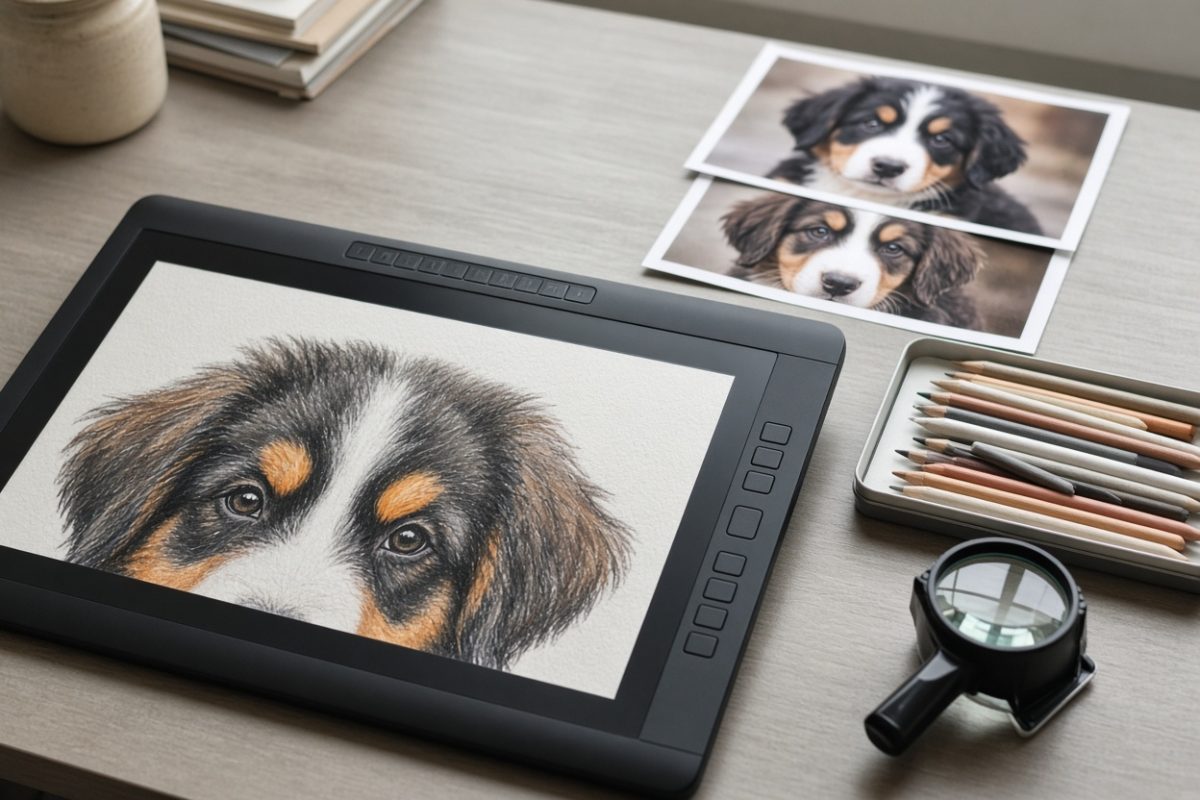
The Bernese Mountain Dog is a great example. It has a black body, rust on the cheeks and legs, and a white blaze and chest. That white often forms a cross shape on the chest.
The Rottweiler and Doberman share tan points. Look for the two small tan dots above the eyes. Missing those dots is a common mistake in quick sketches.
Border Collies vary widely, but many have a white collar, blaze and tail tip. A good artist reflects the real variety instead of painting one generic version.
The Boston Terrier wears its famous tuxedo. A white muzzle band, blaze and chest are expected. Without them, it might be mistaken for a French Bulldog.
Beyond Colour: Structure and Expression
Markings are only part of the story. An accurate dog portrait also respects how the breed is built. Colour on the wrong shape still looks wrong.
Check the ear set first. Is the breed prick-eared, drop-eared, or somewhere in between? A Corgi with floppy ears simply isn’t a Corgi.
Next, look at the head. Some breeds have a deep stop between forehead and muzzle. Others have a long, smooth line. Artists often blur these differences.
Eye shape matters, too. Almond eyes, round eyes and deep-set eyes all create different expressions. The eyes carry much of a breed’s personality.
Finally, consider coat texture. A wiry terrier coat reads differently from a silky spaniel coat. Good artists show texture, not just flat colour.
Common Mistakes to Watch For
Once you know what to look for, errors start jumping out. Many come from working with poor reference photos. Others come from drawing a “generic dog” and recolouring it.
- Symmetrical markings on breeds that are naturally uneven.
- Missing eyebrow dots on tan-pointed breeds.
- White patches in places the breed rarely has them.
- Colours that don’t exist in the breed at all.
- One body shape reused for very different breeds.
Symmetry is a sneaky one. Real dogs are often lopsided. A blaze may drift to one side, and that quirk is part of the charm.
Colour accuracy also matters. Some breeds come in a narrow range of shades. A blue Golden Retriever might look playful, but it isn’t true to the breed.
Stylized art can still be an accurate dog portrait. Even bold or floral styles can keep the key markings. Simplifying is fine. Inventing is where things go astray.
How to Judge a Portrait Like an Owner
You don’t need to be an artist to evaluate dog art. You just need a habit of looking closely. Start with the overall impression, then zoom in.
Ask yourself one simple question first. Would you name the breed instantly without a label? If you hesitate, something is likely missing.
Then check the face. Look at markings around the eyes, muzzle and forehead. Owners usually look here first, so artists should get it right here first.
Compare the piece to a few real photos of the breed. Look for ear shape, head shape and pattern placement. Differences become obvious side by side.
An accurate dog portrait comes from careful observation, not fancy technique. A portrait that respects the breed’s markings will always feel more like the dog you love.
→Handmade Holiday Gifts for People Who Have Everything→Who Actually Makes Your Decor? Inside an In-House Studio
Frequently Asked Questions
Why do breed markings matter so much in a dog portrait?
Markings are the colour patterns on a dog's coat, like patches, points, masks and blazes, and many are part of a breed's official description. Owners have studied their dog's face thousands of times, so they'll spot a misplaced patch right away. Get the markings wrong and the whole piece feels off, even if the shape is right.
What are the main coat marking patterns I should know?
The big ones are tan points, tricolour, merle, brindle, piebald or parti, saddle and mask. Each has its own logic. Tan points show up in predictable spots over the eyes, on the muzzle, chest and legs, while merle is a mottled patchwork that's different on every dog. Once you can name these patterns, it's much easier to see what an artist got right and what they guessed.
How can I tell if brindle or merle has been drawn accurately?
With brindle, the dark stripes should follow the body's contours. If they run perfectly straight, the dog can end up looking like a cartoon tiger. Merle should keep its marbled texture rather than being flattened into simple spots, since that's one of the most common shortcuts artists take.
What should I look for in a Rottweiler or Doberman portrait?
Both breeds have tan points, so check for the two small tan dots above the eyes. Missing those dots is a common mistake in quick sketches. The tan should also appear on the muzzle, chest and legs where you'd expect it, not wander randomly around the body.
Which breeds are hardest to get right because of their markings?
Breeds defined almost entirely by their markings leave very little room for guessing. A Bernese Mountain Dog needs its black body, rust on the cheeks and legs, and a white blaze and chest that often forms a cross. A Boston Terrier needs its tuxedo of white muzzle band, blaze and chest, or it might be mistaken for a French Bulldog.
Does LC Designs offer dog breed designs on its products?
Yes, LC Designs makes breed-specific mugs, tumblers, earrings, ceramic coasters and ceramic car coaster sets, with many dog breeds shown among flowers. Products are titled by breed, like "Golden Retriever in Flowers Ceramic Car Coaster Set", so you can search for your own dog's breed. Everything is printed and finished in-house at the studio and sold as listed at lcdesigns.cc.

