
Industry Insights
What Sublimation Actually Is, and How It Wears
Sep
TL;DR
Sublimation turns ink into a gas that bonds inside a surface coating, so the design sits in the piece rather than on top of it.
- Run a finger over a printed item: a raised outline, a shine difference or a lifting corner means a layer was applied on top, while a smooth uniform surface points to sublimation.
- Sublimation only works on polymer-coated or polymer-friendly materials like ceramic, so bare cotton, untreated wood and plain metal won't hold the ink.
- Because the colour lives under the top layer, sublimated pieces fade and scuff slowly instead of peeling, so watch the condition of the surface itself rather than the print.
What Sublimation Actually Is
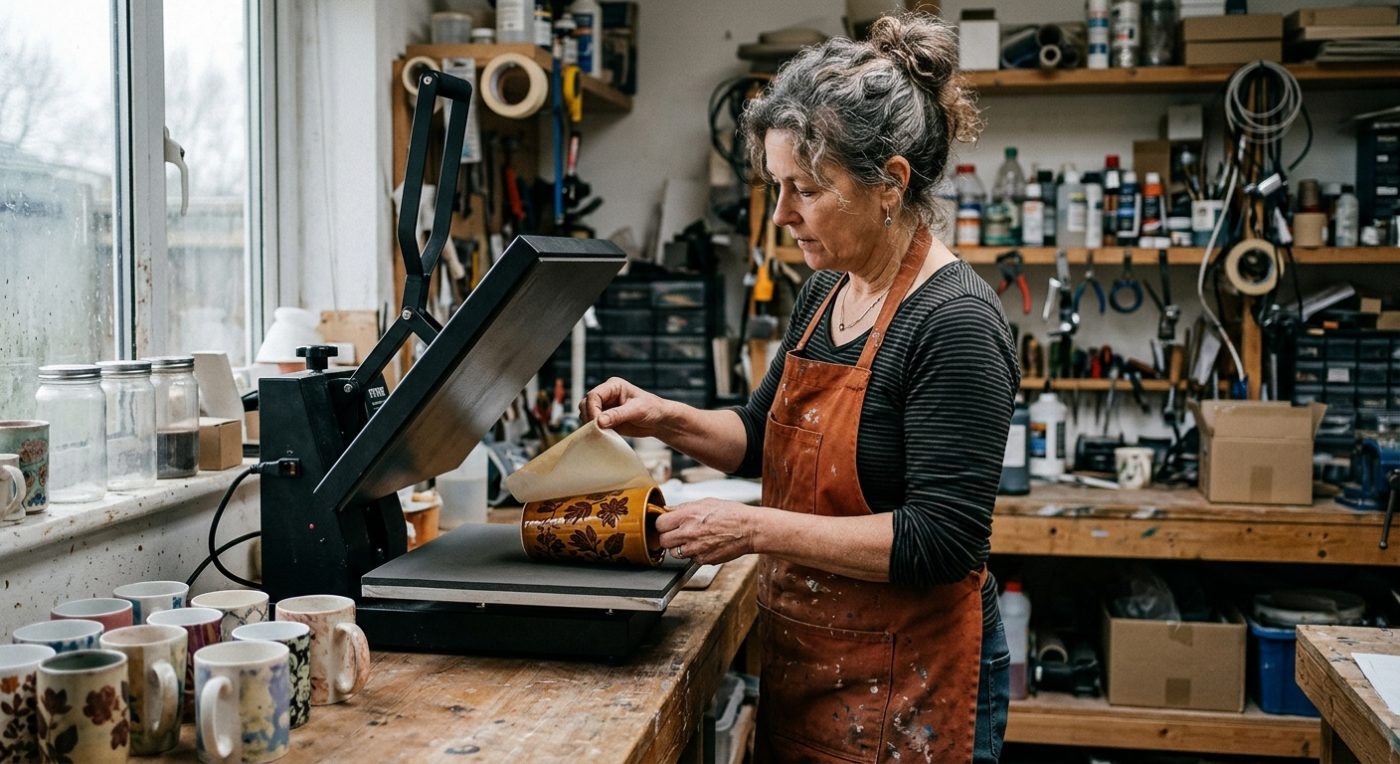
Sublimation printing is one of those terms that gets tossed around a lot without anyone explaining what sublimation actually is. So here’s the plain version. It’s a way of putting a design onto a surface using heat, pressure and special ink.
The ink starts as a solid on a sheet of transfer paper. Under heat, it skips the liquid stage and turns straight into a gas. That’s the part the word “sublimation” actually refers to.
Now you know how sublimation holds up, browse the ceramic coasters we press and finish in our own studio at lcdesigns.cc.
Learn more →That gas moves into the coating on the item itself. Then it cools and turns solid again, locked inside the surface. The design isn’t sitting on top. It’s part of the piece.
This is why a sublimated coaster feels smooth when you run a finger across it. There’s no raised edge, no ridge where the image stops. The colour lives under the glaze-like top layer.
How It Differs From a Sticker or a Decal
A lot of printed giftware is really just a layer added on top. Vinyl decals, transfers and stickers all work that way. They sit above the surface and they’re held there with adhesive.
That’s not a knock on them. They can look sharp and they’re quick to make. But a layer sitting on top has edges, and edges are where wear starts.
With sublimation printing there’s no separate layer to lift. Nothing to peel at the corner. Nothing to catch on a fingernail or a car cup holder.
You can usually tell the difference by touch alone. Here’s what to feel for:
- A raised outline around the design means something was applied on top
- A slight shine difference between image and background suggests a film layer
- A completely smooth, uniform surface points to sublimation
- Lifting or curling at a corner only happens with applied layers
It’s a small thing to notice. But it tells you a lot about how the piece will age on your shelf or in your car.
Why the Surface Matters as Much as the Ink
Sublimation only works on surfaces that can accept the gas. That usually means a polymer coating or a material that’s polymer-friendly. Ceramic is a good match, which is why coasters work so well.
The quality of that coating decides a lot. A thin or uneven coating gives muddy colour and soft edges. A good one gives you sharp lines and deep tone.
This is also part of what sublimation actually is in practice: you can’t sublimate onto just anything. Bare cotton, untreated wood and plain metal won’t hold the ink. The chemistry simply isn’t there.
When we’re working on ceramic coasters and car coaster sets, the blank matters before a single drop of ink is involved. Get the surface wrong and the best design in the world still looks flat.
How Sublimated Pieces Actually Wear
Here’s the honest answer: sublimation wears well, but nothing lasts forever. What you get is a design that fades and scuffs slowly rather than peeling suddenly.
Because the colour is inside the surface, normal handling doesn’t shift it. Setting a mug down on a coaster hundreds of times won’t scrape the image off. There’s no top layer to scrape.
The thing to watch is the surface itself. If the ceramic or the coating gets chipped or deeply scratched, the design goes with it. Protect the surface and you protect the print.
Strong sun over long stretches is the other factor. Any printed colour will shift eventually under constant direct light. A coaster living on a sunny windowsill for years will look different than one in a cabinet.
But in everyday use, on a side table or in a cup holder, sublimated ceramic holds up. That’s the whole point of the method.
Looking After Sublimated Ceramic
The care rules are pretty simple. You’re mostly looking after the ceramic and its coating, not the ink underneath.
Ceramic car coasters are designed to absorb moisture from a cup. That’s their job. They’ll take on a little damp and dry out again on their own.
Here’s what we’d suggest for keeping them looking sharp:
- Wipe with a soft damp cloth rather than scrubbing
- Skip abrasive cleaners, scouring pads and bleach
- Let a damp coaster air dry fully before stacking it
- Don’t put ceramic coasters in the dishwasher
- Store them flat so edges don’t chip against each other
- Keep them out of long stretches of direct sunlight
If a coaster picks up a ring stain, a gentle wipe usually handles it. Patience beats pressure here. Hard scrubbing risks the coating, and the coating is what’s holding your design.
Sculptures and 3D printed pieces are a different story, since they’re not sublimated. Those just want dusting and a spot away from heat.
Why We Print Everything Ourselves
All the printing, sublimation and finishing happens right in our studio. Nothing gets ordered in finished and relabelled. That’s a deliberate choice.
When you press your own pieces, you see every one before it goes in a box. A colour that came through dull, an edge that didn’t sit right, a design slightly off centre. Those get pulled.
It also means we understand how our own pieces behave. We know what sublimation actually is at the press, what a good press looks like and what a rushed one looks like. That knowledge is hard to get secondhand.
Our catalogue runs long and specific because of it. Dog breeds, sea life, automotive designs, all sold as listed. Some designs are licensed from other creators and printed under those licences.
Knowing what sublimation actually is changes how you look after it. A print that lives inside the surface asks for different care than one stuck on top, and that’s worth knowing before the first scrub.
→Made in the Studio, Not Ordered From a Warehouse→Voronoi and Fluted: Reading 3D Print Textures
Frequently Asked Questions
What is sublimation printing, in plain terms?
Sublimation is a way of putting a design onto a surface using heat, pressure and special ink. The ink starts as a solid on transfer paper, turns straight into a gas under heat, and moves into the polymer coating on the item itself before cooling back into a solid. The result is a design that lives inside the surface rather than sitting on top of it.
How is sublimation different from a vinyl decal or sticker?
Decals, transfers and stickers are a separate layer added on top of the surface and held there with adhesive, which means they have edges. Sublimation has no separate layer at all, so there's nothing to lift, peel or catch on a fingernail. It's the main reason a sublimated coaster feels completely smooth under your finger.
How can I tell if a coaster is sublimated or has something applied on top?
Touch is usually enough. A raised outline around the design, or a slight shine difference between the image and the background, points to an applied layer, and lifting or curling at a corner only happens with applied layers. A completely smooth, uniform surface with no ridge where the image stops points to sublimation.
Why does sublimation only work on certain materials?
The gas needs a surface that can accept it, which usually means a polymer coating or a polymer-friendly material. Ceramic is a good match, which is why our ceramic coasters and car coaster sets work so well with this process. Bare cotton, untreated wood and plain metal won't hold the ink because the chemistry simply isn't there.
Will the design on my coaster peel or scrape off over time?
There's no top layer to peel or scrape, because the colour sits inside the surface coating. Setting a mug down hundreds of times won't lift the image the way it can with an applied decal. Sublimated pieces fade and scuff slowly rather than failing suddenly, though nothing lasts forever.
Does the blank itself affect how a printed coaster looks?
Yes, and more than people expect. A thin or uneven coating gives muddy colour and soft edges, while a good coating gives sharp lines and deep tone. We choose the blank before a single drop of ink is involved, because the best design in the world still looks flat on the wrong surface.

